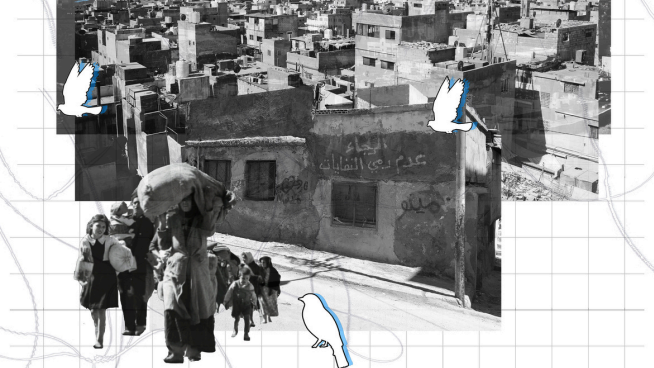
_PHD_Thesis_In Search of Al Wehdat Camp
A Study of Paths, Edges and Walls and their Production of Transient Territories in Palestinian Refugee Camps
Author: N.A. Qudah – Architecture and the Built Environment TU Delft
link to thesis pdf
more information:
Abstract
Al Wehdat Camp, like all Palestinian refugee camps, was built in response to Al Nakba, as a space of temporary refuge to generations of Palestinian refugees who were uprooted from their homes. In this research, I conceptualized home as a multi-scalar territory that exists in different places, in different time intervals, all at once, through a spatio-temporal simultaneity that produces Al Wehdat Camp as a transient territory, that exists here and there, now and then, at home and in exile. Through the different chapters of this dissertation, I studied those different scales of home, the home-land, the home-city, the home-camp and the home-home, through an interdisciplinary research approach and framework that were built around three pillars: the body, movement, and territory. In my research, I studied a number of paths of displacement that the Palestinian refugees have traveled across during their uprooting from Palestine, mapping their movement to get to Al Wehdat Camp. Through that tracing of the different paths, I was able to conceptualize the camp as a point that exists at the intersection of a number of paths that have led the Palestinian refugees to the camp and also allowed them to move past it to different locations within the city. That continuous movement of displaced bodies from Palestine to Jordan have allowed the Palestinian refugees to transgress the colonial borders that has disconnected them from the space of the home-land, and allowed them to reproduce the space of Palestine in Al Wehdat Camp.
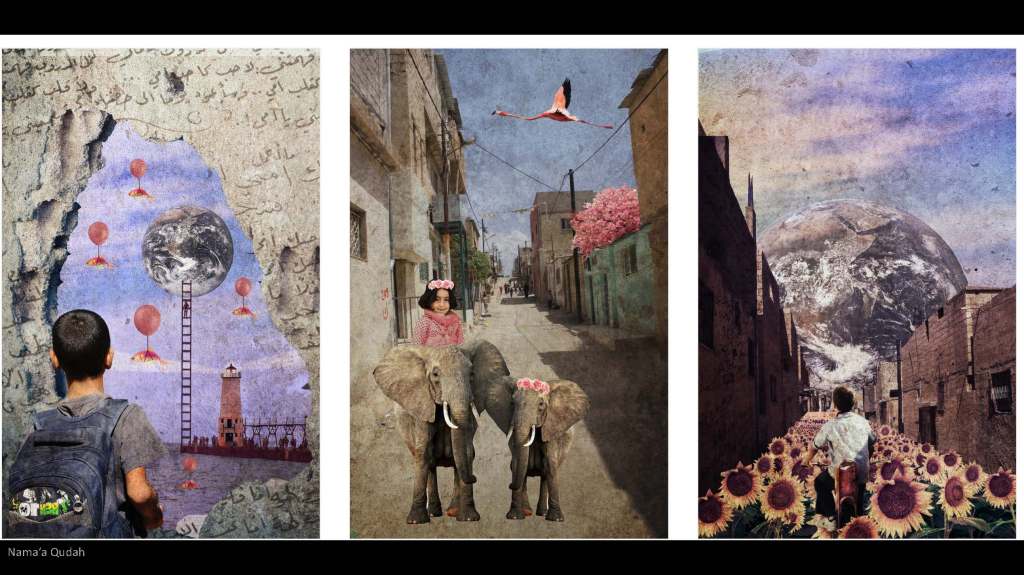
_competition: Building Future Palestine Competition
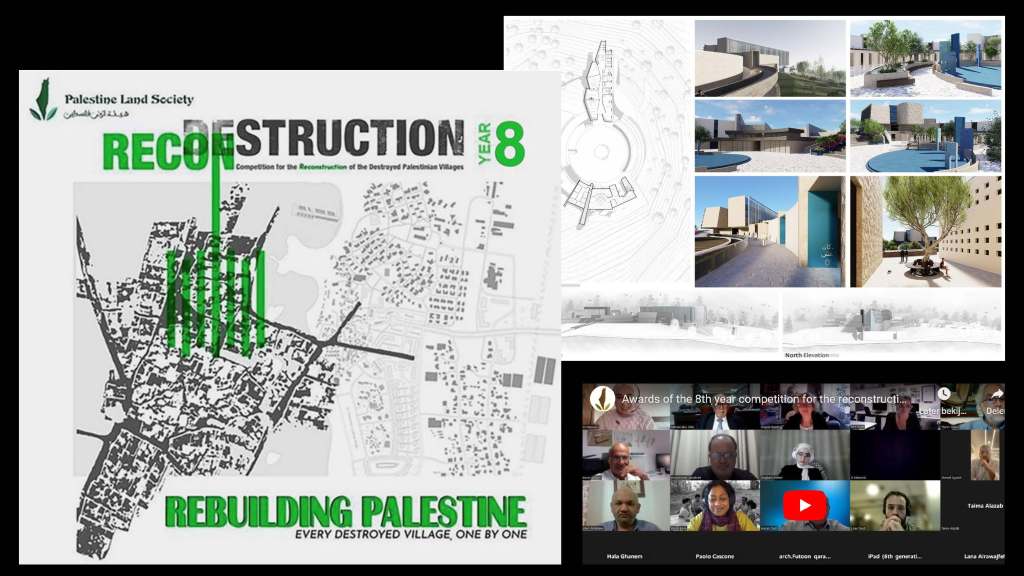
In the 8th Annual Reconstruction of Destroyed Palestinian Villages Competition.
more information:
On 13 Sept 2024, the awards were announced in London for the 8th year Competition for the reconstruction of destroyed Palestinian villages by Israel in 1948. This is in fulfillment of UN resolution no 194 and many other resolutions calling for the right of the Palestinians to return to their homes in Palestine and their right for compensation for the Israeli use of their property since 1948.
Notably absent this year are students from Gaza Strip, because of the Israeli Genocide in Gaza. This term is called Gaza Term, in honour of over 200,000 Palestinians killed or injured, mostly women and children. One of those killed is Maha Jamal Mansour, the winner of Year 4 awards. Israeli soldiers murdered her in her home. We lost one brilliant talent.
This year 2024, 54 architectural students from 12 universities in Palestine, Jordan and Lebanon participated and produced unique projects for the reconstruction of Abu Shusha (Haifa), Ayn az Zaytun, Al Mazar (Jenin), Bayt Jibrin and Saffouria. The British Jury were the distinguished architects and professors Nasser Golzari, Yara Sharif, Angela Brady and Rim Kalsoum.
In the last 8 years, over 300 architectural students from Palestine and the Middle East participated and produced detailed reconstruction plans for 60 villages distributed over several distinct geographical regions of Palestine.
This competition is run by the British company, Palestine Land Society (PLS) in London. PLS is UN accredited by CEIRRP. Its founder and president is Dr Salman Abu Sitta.
The video of Year 8 announcement of awards is here.
https://youtu.be/z1qQXT-_1No
Details of this competition over the years are reported in PLS website at:
https://www.plands.org/en/competition-news
https://www.plands.org/en/competition-news/competition-history-and-operation-year-8
 architectureandcolonialism.org